Best OEMs for AI GPU Servers: Tier List (2026)
If you're buying AI servers, you're choosing between OEMs (original equipment manufacturers) and ODMs (original design manufacturers). AWS, Google, Meta, Microsoft, and Oracle buy direct from ODMs like Foxconn, Quanta, and Wistron, skipping the OEM entirely. For enterprises that don't operate at hyperscaler scale, the OEM choice determines pricing, lead times, and support quality. Dell is the enterprise standard. The next tier includes Supermicro, Lenovo, HPE, and Cisco.
The OEM tier list
| OEM | Founded | Server Revenue (Est. 2025) |
|---|---|---|
 | 1984 | $43.6B |
 | 1993 | $21.3B |
 | 1939* | $17.8B |
 | 1984 | $14.5B |
 | 1984 | $6B |
 | 1986 | $7B |
 | 1989 | $3B |
* HP was founded in 1939. HPE spun out on November 1, 2015. Dell figure includes servers, storage, and networking. Cisco estimated from IDC market share data (not broken out in filings). ASUS estimated from segment mix.
OEM pricing relative to Dell (baseline)
An 8x H100 node runs $200-300K, so a 10% variance in upfront hardware pricing matters when you're buying dozens of servers. Downtime on an 8x H100 cluster also costs tens of thousands of dollars per day.
Who actually builds your AI server
An NVIDIA H100 SXM5 inside a Dell PowerEdge XE9680 is the same chip as the one inside a Supermicro SYS-421GE or an HPE Cray XD670. The GPU die came off the same TSMC production line, went through the same NVIDIA testing, and landed on the same HGX baseboard design.
What differs is everything around it: the chassis, the thermal solution, the power delivery, the BMC (baseboard management controller) firmware, and the management software you use to monitor the thing in production.
The supply chain runs:
- → NVIDIA designs the GPU and baseboard
- → TSMC (Taiwan Semiconductor) fabricates the silicon
- → NVIDIA assembles and tests the HGX baseboard
- → OEM (original equipment manufacturer) designs the server around the HGX baseboard
- → ODM (original design manufacturer) assembles the server
- → OEM validates, brands, and adds support
- → VAR (value-added reseller) or direct sale to you
OEMs design the server enclosure and cooling system, select the CPUs and memory, write the firmware and management stack (iDRAC, iLO, XClarity), validate the full configuration, and sell it under their brand with a warranty and support contract. They charge a premium for this work, and for the 24/7 phone number you call when a GPU goes down at 2 AM.
ODMs do the physical assembly. Foxconn, Quanta, Wistron, and Inventec are the factories. They build the boxes that Dell, HPE, and Lenovo put their logos on. Supermicro is the exception: it does more in-house manufacturing through its San Jose facilities and its Taiwan-based affiliate Ablecom.
The OEM markup covers extensive testing, validation, firmware, and support, the 24/7 phone number and next-day parts. But most AI server volume doesn't flow through OEMs at all. Hyperscalers design their own server specs and contract directly with ODMs, cutting out the OEM layer and its margin entirely.
Dell
Dell annual revenue (not just servers)
Michael Dell founded PC's Limited in 1984, a 19-year-old freshman at UT Austin with $1,000. He assembled upgrade kits in his dorm room, dropped out after one year, and built the company that would become the world's largest technology infrastructure provider.
The first product was the Turbo PC, priced at $795, undercutting IBM. Dell went public in 1988 at an $85 million market cap. By 1992, he was on the Fortune 500, the youngest CEO on the list at 27. [1]Dell Technologies, "How We Got Here" corporate timeline (accessed March 2026)https://corporate.delltechnologies.com/en-us/about-us/who-we-are/timeline.htm
Dell reached No. 1 in US Intel-based server shipments in 2001. [1]Dell Technologies, "How We Got Here" corporate timeline (accessed March 2026)https://corporate.delltechnologies.com/en-us/about-us/who-we-are/timeline.htm The 2016 merger with EMC for $67 billion was the largest technology acquisition in history at the time. [1]Dell Technologies, "How We Got Here" corporate timeline (accessed March 2026)https://corporate.delltechnologies.com/en-us/about-us/who-we-are/timeline.htm As of early 2026, Dell reports $113.5 billion in revenue with an $85 billion market cap. [2]Dell Technologies, "Q4 FY26 Earnings Results" (February 2026)https://www.businesswire.com/news/home/20260226276981/en/Dell-Technologies-Delivers-Fourth-Quarter-and-Full-Year-Fiscal-2026-Results
Dell booked $12.1 billion in AI server orders in Q1 FY26 and maintained a $14.4 billion AI server backlog as of April 2025. [3]Dell Technologies, "Q1 FY26 Financial Results" (May 2025)https://investors.delltechnologies.com/news-releases/news-release-details/dell-technologies-delivers-first-quarter-fiscal-2026-financial 98 of the Fortune 100 are Dell customers. [4]Dell Technologies, "FY25 Annual Report" (2025)https://investors.delltechnologies.com/
The flagship AI platforms: PowerEdge XE9680 (8x H100 or H200 SXM5), XE9712 (8x B300 HGX), and XE9680L (8x B200 with direct liquid cooling, $500-600K range).
Dell's ProSupport Plus offers 4-hour onsite replacement with predictive failure analysis; some of the best support in the industry. [5]Dell Technologies, "ProSupport Plus for Infrastructure" service description (accessed March 2026)https://www.dell.com/en-us/learn/assets/shared-content~data-sheets~en/documents~dell-prosupport-plus-datasheet_en.pdf Dell Financial Services also provides financing options.
Dell is the pricing baseline we choose to measure the rest of the market against. Dell entered FY27 with a $43 billion AI server backlog, so availability depends on configuration and allocation priority. [2]Dell Technologies, "Q4 FY26 Earnings Results" (February 2026)https://www.businesswire.com/news/home/20260226276981/en/Dell-Technologies-Delivers-Fourth-Quarter-and-Full-Year-Fiscal-2026-Results For Fortune 500 procurement departments with existing Dell master agreements, paying Dell pricing is a non-decision.
Supermicro
Supermicro annual revenue (not just servers)
Charles Liang founded Supermicro on November 1, 1993, with his wife Sara Liu. Five people, San Jose, California. Liang is Taiwanese-American, educated at National Taiwan University of Science and Technology and UT Arlington, previously president of Micro Center Computer, a motherboard design firm. [6]Supermicro, "About Us" (accessed March 2026)https://www.supermicro.com/en/about
Supermicro went public on NASDAQ (ticker SMCI) in March 2007. [7]Reuters, "Super Micro Computers IPO raises $64 mln, below range" (March 2007)https://www.reuters.com/article/markets/us/super-micro-computers-ipo-raises-64-mln-below-range-idUSN28373282/ Fiscal year 2025 revenue was $22 billion, up 47% year-over-year. [8]Supermicro, "Q4 and Full Fiscal Year 2025 Financial Results" (August 2025)https://ir.supermicro.com/financials/quarterly-results/default.aspx
On the product side, Supermicro is hard to beat. Lead times of 2-4 weeks are the fastest in the industry, half the wait of Dell or HPE. The Building Block architecture allows rapid custom configurations. Rack density reaches 96 GPUs per 52U. Supermicro was first to market with the GB200 NVL72 rack-scale solution, the $3 million, 72-GPU system that hyperscalers are deploying for next-generation training. [9]NVIDIA, "GB200 NVL72" product page (accessed March 2026)https://www.nvidia.com/en-us/data-center/gb200-nvl72/
Pricing undercuts Dell and HPE for comparable configurations. Supermicro's in-house manufacturing through San Jose and its Taiwan affiliate Ablecom removes the ODM margin that Dell and HPE pay, and a leaner sales and support organization means lower overhead baked into the price. A comparable Supermicro configuration typically comes in meaningfully lower than Dell or HPE.
Then there's the other side.
From fiscal 2015 through 2017, the company ran widespread accounting violations. It prematurely recognized revenue on goods sent to warehouses but not delivered. It shipped products before deals were authorized. It shipped misassembled goods to customers. It booked $45 million in revenue by counting shipment as delivery for one customer and approved $150 million from a chronically overdue customer. [10]SEC, "In the Matter of Super Micro Computer, Inc." (August 2020)https://www.sec.gov/divisions/enforce/claims/super-micro-computer.htm
The SEC fined Supermicro $17.5 million in August 2020. CEO Liang reimbursed $2.1 million in stock profits. CFO Howard Hideshima paid $350,000. Supermicro was delisted from NASDAQ in 2018 and relisted in 2020. [10]SEC, "In the Matter of Super Micro Computer, Inc." (August 2020)https://www.sec.gov/divisions/enforce/claims/super-micro-computer.htm
Four years later, it happened again.
In August 2024, short-seller Hindenburg Research published a report alleging accounting manipulation and sanctions evasion. [11]Hindenburg Research, "Super Micro: Fresh Evidence of Accounting Manipulation" (August 2024)https://hindenburgresearch.com/smci/ Supermicro delayed its annual 10-K filing. In October 2024, auditor Ernst & Young resigned, stating it was "unwilling to be associated" with management's financial representations. An independent committee found "no fraud" but acknowledged "significant material weaknesses in internal controls." Supermicro filed its delayed financials on February 25, 2025, narrowly avoiding a second NASDAQ delisting. CFO David Weigand departed. BDO USA replaced EY as auditor. [12]The Register, "Supermicro finally files long-delayed 10-K, avoids delisting" (February 2025)https://www.theregister.com/2025/02/26/supermicro_10k_filing/
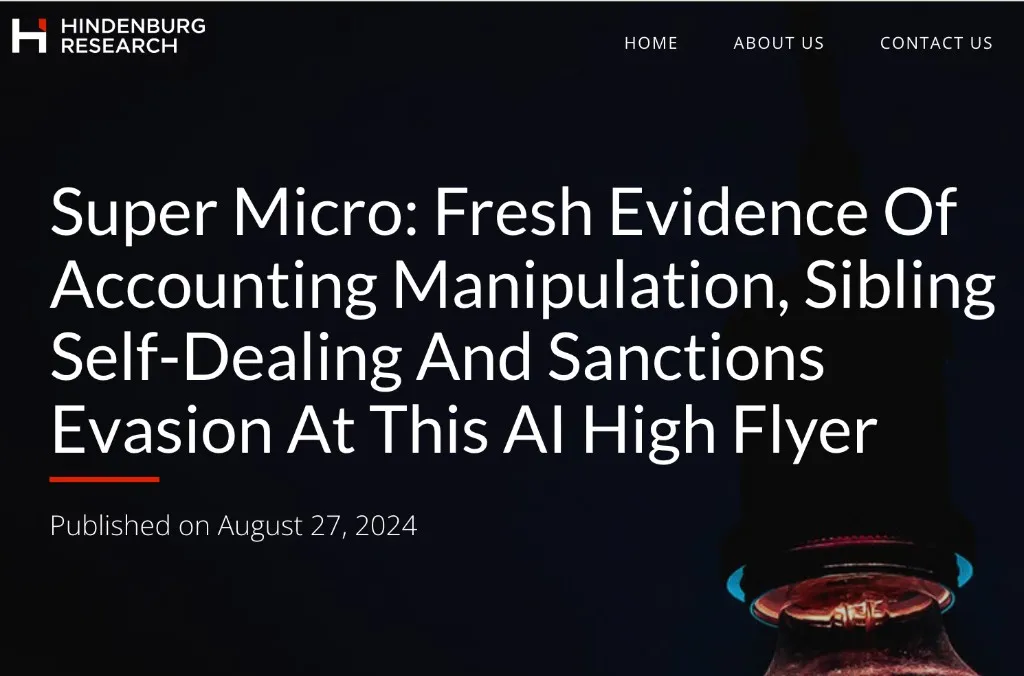
Then there's the family business. In 1996, Supermicro established Ablecom as a manufacturing subsidiary in Taiwan, run by Charles Liang's brothers Steve and Bill. Charles and Sara own approximately 31% of Ablecom. Steve Liang and family own close to 50%. A separate entity, Compuware, is also run by the Liang brothers.
Together, Ablecom and Compuware received $983 million from Supermicro over three years. As of 2020, 99.8% of Ablecom's US exports and 99.7% of Compuware's US exports went to Supermicro. The arrangement: Supermicro sends components to these entities, which reassemble them and sell them back. [11]Hindenburg Research, "Super Micro: Fresh Evidence of Accounting Manipulation" (August 2024)https://hindenburgresearch.com/smci/
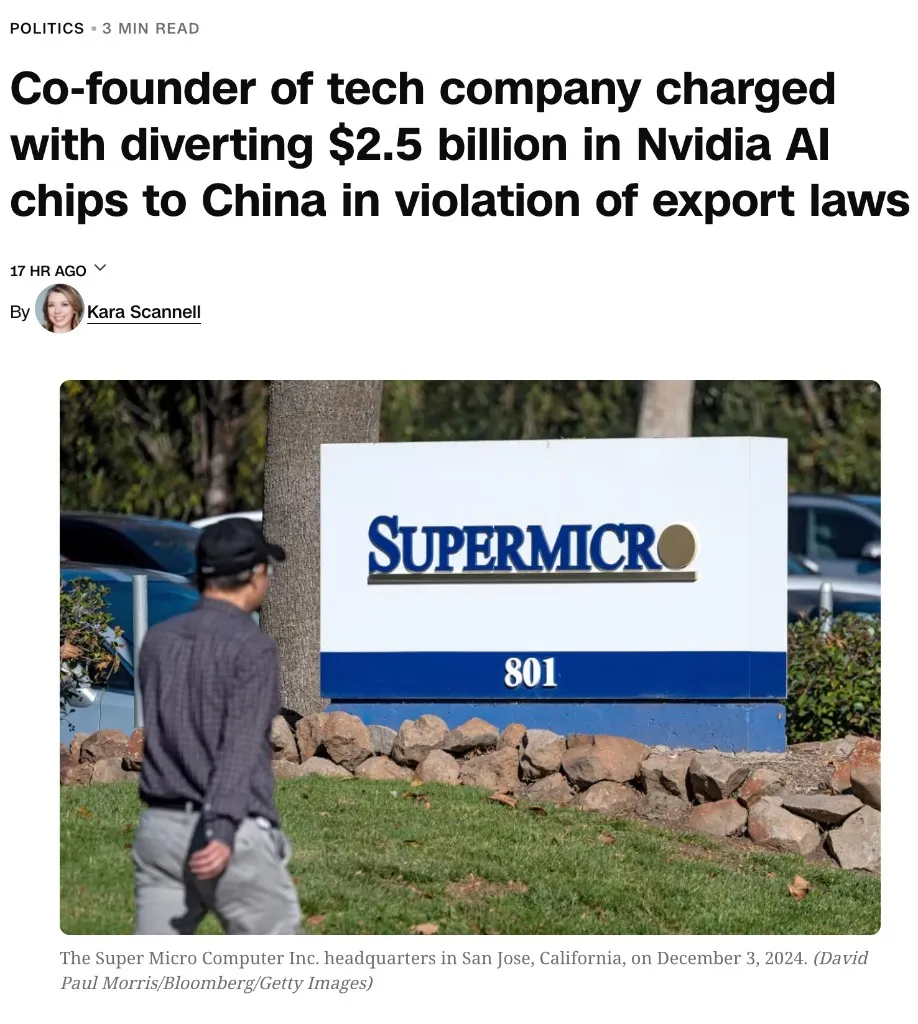
In March 2026, the DOJ indicted Supermicro co-founder and SVP Yih-Shyan "Wally" Liaw, sales manager Ruei-Tsang "Steven" Chang, and contractor Ting-Wei "Willy" Sun for smuggling $2.5 billion in servers containing NVIDIA B200 and H200 GPUs to China in violation of US export controls. The defendants used a pass-through company in Southeast Asia to place orders, created falsified documents, and warehoused thousands of non-working "dummy" servers to deceive auditors from both Supermicro and the Commerce Department. They used a hair dryer to remove and alter serial number labels on server boxes. Liaw was arrested and released on bail. Chang remains a fugitive. All three face up to 30 years in prison. [13]The Register, "Supermicro co-founder charged over $2.5B GPU sales to China" (March 2026)https://www.theregister.com/2026/03/20/supermicro_nvidia_gpu_charges/ Supermicro's stock fell approximately 25% on the news.
HPE
HPE annual revenue (not just servers)
Bill Hewlett and Dave Packard founded Hewlett-Packard on January 1, 1939, in a one-car garage at 367 Addison Avenue, Palo Alto. Their company name order was chosen by coin toss. Both were Stanford graduates, mentored by professor Fred Terman, who urged them to start their own company.
The first product was the HP Model 200A audio oscillator. Walt Disney Studios bought eight for the surround-sound system in Fantasia (1940). That garage is California Historical Landmark No. 976, the "Birthplace of Silicon Valley." [14]HPCA Archives, "The Founding of HP" (accessed March 2026)https://www.hewlettpackardhistory.com/story/the-founding-of-hp/
On November 1, 2015, Hewlett-Packard divided into HP Inc. (PCs and printers) and Hewlett Packard Enterprise (servers, storage, networking, services). HPE took the enterprise business. [15]GlobeNewsWire, "Hewlett Packard Enterprise Launches as Enterprise Technology Leader" (November 2015)https://www.globenewswire.com/news-release/2015/11/02/944113/0/en/Hewlett-Packard-Enterprise-Launches-as-Enterprise-Technology-Leader-With-53-Billion-in-Annual-Revenue.html
What HPE kept: the server business and a deep bench in high-performance computing, strengthened by the $1.3 billion Cray acquisition in 2019. [16]Reuters, "HPE to buy supercomputer maker Cray in $1.30 billion deal" (May 2019)https://www.reuters.com/article/us-cray-m-a-hpe/hewlett-packard-enterprise-to-buy-supercomputer-maker-cray-in-1-30-billion-deal-idUSKCN1SN1CN/ HPE builds some of the world's largest supercomputers. That HPC heritage matters for AI. Training a large model at scale is operationally similar to running a supercomputer workload, and HPE has decades of experience with the cooling, networking, and job orchestration involved.
As of fiscal year 2025, HPE reports $34.3 billion in revenue. HPE booked $6.8 billion in AI system orders in fiscal 2025. GreenLake, HPE's consumption-based model, has $3.2 billion in annual recurring revenue and lets enterprises deploy on-premise hardware with cloud-like economics, paying for what they use. [17]HPE, "Q4 Fiscal Year 2025 Earnings" (December 2025)https://investors.hpe.com/~/media/Files/H/HP-Enterprise-IR/documents/q4-2025/q4-2025-earnings-press-release.pdf
The AI server lineup: Cray XD670 (8x B300 HGX), ProLiant XD685 (8x H100 SXM5 with direct liquid cooling), and a forthcoming GB300 NVL72 offering. Warm water liquid cooling supports 45-50°C inlet temperatures.
Pricing is competitive with Dell, with the final number depending on configuration, contract terms, and whether GreenLake consumption pricing applies. Lead times tend to run longer than competitors given HPE's complex product portfolio and custom liquid cooling integrations. Government and research institutions are HPE's core buyers. If you're a national lab or a university, HPE probably already has the contract vehicle.
Lenovo
Lenovo annual revenue (not just servers)
Liu Chuanzhi founded Legend Holdings in 1984, with 11 researchers from the Chinese Academy of Sciences' Institute of Computing Technology. Initial capital: RMB 200,000. The office was 20 square meters in Beijing.
The first product was the Han Card (1985), an expansion board that let PCs process Chinese characters. By 1986, Legend was distributing IBM and HP hardware in China. The first self-branded PC came in 1990. Legend rebranded as Lenovo in 2003.
Lenovo's server business came through acquisition. In 2005, Lenovo bought IBM's ThinkPad consumer PC line for $1.75 billion, transforming overnight from the No. 9 PC manufacturer into No. 3. [18]Lenovo, "Lenovo Completes Acquisition of IBM's Personal Computing Division" (May 2005)https://news.lenovo.com/pressroom/press-releases/lenovo-completes-acquisition-ibms-personal-computing-division/ In October 2014, Lenovo closed the acquisition of IBM's x86 server business for $2.1 billion, taking over the System x, BladeCenter, Flex System, NeXtScale, and iDataPlex product lines. [19]Reuters, "Lenovo says $2.1 billion IBM x86 server deal to close" (September 2014)https://www.reuters.com/article/us-lenovo-ibm-deals-idUSKCN0HO08N20140929/ Approximately 7,500 IBM employees transferred to Lenovo.
The IBM heritage gives Lenovo's server business credibility that a Chinese-founded company wouldn't otherwise carry in Western enterprise markets. The ThinkSystem brand traces directly back to IBM's engineering.
FY24/25 revenue: $69.1 billion. $18 billion market cap (Hong Kong-listed). [20]Lenovo Group, "Q4 and Full Year Financial Results 2024/25" (May 2025)https://www.businesswire.com/news/home/20250521417967/en/Lenovo-Group-Q4-and-Full-Year-Financial-Results-202425 The Infrastructure Solutions Group reports $14.5 billion in revenue. [20]Lenovo Group, "Q4 and Full Year Financial Results 2024/25" (May 2025)https://www.businesswire.com/news/home/20250521417967/en/Lenovo-Group-Q4-and-Full-Year-Financial-Results-202425Lenovo is the No. 3 server vendor globally. [21]IDC, "Worldwide Server Market Q4 2024" (2025)https://www.idc.com/promo/server
AI server flagships: ThinkSystem SR680b (8x B300 HGX), SR675 V3 (8x H100/H200), SD665 N V3 (Neptune direct water cooling). Neptune is Lenovo's warm-water cooling technology, supporting 45-50°C inlet temperatures.
Pricing is competitive with Dell and HPE, with Lenovo typically positioning aggressively to win deals against the two larger incumbents. Premier Support covers 24/7 across more than 100 markets, one of the broadest geographic reaches of any server OEM. [22]Lenovo, "Premier Support" (accessed March 2026)https://techtoday.lenovo.com/ww/en/premier
For multinational enterprises with data centers in Singapore, Frankfurt, and Virginia, Lenovo's global support network matters. For a US-only deployment, less so.
Cisco
Cisco annual revenue (not just servers)
Leonard Bosack and Sandra Lerner founded Cisco Systems in December 1984. Both worked at Stanford: Bosack managed the computer science lab, Lerner oversaw computers at the business school. They built technology to connect their two LANs, 500 yards apart on campus. No existing company wanted to commercialize networking at the time. [23]Britannica, "Cisco Systems" (accessed March 2026)https://www.britannica.com/money/Cisco-Systems-Inc
Named after San Francisco. The logo represents the Golden Gate Bridge. Cisco went public in 1990 at a $224 million market cap. Both founders departed the same year. [23]Britannica, "Cisco Systems" (accessed March 2026)https://www.britannica.com/money/Cisco-Systems-Inc The company became the plumbing of the internet, passing $500 billion in market cap in March 2000, making it briefly the world's most valuable company. [24]Yahoo Finance, "This Day In Market History: The Cisco Systems IPO" (accessed March 2026)https://finance.yahoo.com/news/day-market-history-cisco-systems-141101826.html
Despite being a networking company, Cisco entered the server market on March 16, 2009, with the Unified Computing System (UCS), code-named "California." [25]Cisco, "Cisco Unleashes the Power of Virtualization with Industry's First Unified Computing System" (March 2009)https://newsroom.cisco.com/c/r/newsroom/en/us/a/y2009/m03/cisco-unleashes-the-power-of-virtualization-with-industry-s-first-unified-computing-system.html Dell, HP, and IBM had been selling servers for decades. Cisco's pitch: converge compute and networking into a single managed platform.
UCS carved out a niche in enterprise data centers, but Cisco never became a server market share leader. The AI GPU portfolio is newer and smaller: UCS C880A (8x B300 HGX), UCS C885A (8x H100/H200), and UCS C845A (2-8 PCIe GPUs on the MGX platform).
Cisco's server business exists to complement its networking business. If you already run Cisco Nexus switches, UCS servers give you unified management through a single pane. Nobody's first thought for AI GPU clusters is Cisco. The networking side, however, shows up in almost every data center on the planet. They're trying to catch up in selling AI equipment to enterprises.
Gigabyte and ASUS
Pei-Cheng Yeh founded Gigabyte Technology in April 1986 in Taipei. The company started as a motherboard manufacturer and still carries that identity. It went public on the Taiwan Stock Exchange in 1999.
Gigabyte's server revenue was projected at around $7.3 billion in 2025, with 94% year-over-year group revenue growth in 2024. Gigabyte is on NVIDIA's priority supply list for GB200 orders and is fulfilling a large order from CoreWeave. Gigabyte started mass production of its US server line in July 2025.
In parallel, ASUS was founded in 1989, also in Taipei, and shares the same motherboard DNA. It secured major AI server orders at GTC 2025 and is now establishing US manufacturing ties. ASUS brings the same board-level engineering depth as Gigabyte, with a broader consumer brand presence backing its enterprise push. [26]Digitimes, "Asus and Gigabyte secure major AI server orders from Nvidia" (February 2025)https://www.digitimes.com/news/a20250224PD212/nvidia-asus-gigabyte-ai-server-supply.html
Both companies price below the major enterprise OEMs. Without the enterprise support overhead and sales organization that Dell, HPE, and Lenovo maintain, Gigabyte and ASUS price aggressively on hardware alone. The trade-off: smaller enterprise support infrastructure, limited global service network, and basic management tools compared to Dell's iDRAC or HPE's iLO.
For system integrators, managed service providers, and organizations with in-house technical teams, Gigabyte and ASUS arguably offer the best hardware value per dollar.
The ODMs behind every brand
When you buy a Dell PowerEdge or an HPE ProLiant, the box was probably assembled in a Foxconn, Quanta, or Wistron factory.
OEM vs ODM server revenue (est.)
Foxconn
Terry Gou founded Hon Hai Precision (Foxconn's parent) in 1974 in Taipei with $7,500. He started making plastic parts for televisions and Atari consoles. The company now operates over 230 manufacturing campuses across 24 countries with more than 900,000 employees. Foxconn builds iPhones, Xboxes, and now AI servers. [27]Foxconn, "Hon Hai Technology Group Announces FY2025 Financial Results" (March 2026)https://www.foxconn.com/en-us/press-center/press-releases/latest-news/1978
In 2025, Foxconn pulled ahead of Quanta and Wistron in the race to build NVIDIA's next-generation AI servers. [28]Digitimes, "Foxconn pulls ahead of Quanta and Wistron in Nvidia AI server race" (September 2025)https://www.digitimes.com/news/a20250925PD212/ Foxconn sees the AI server market splitting 80/20 between GPU and ASIC-based systems, with GPU servers remaining dominant through 2027. The company expects high double-digit AI server shipment growth through 2026. [29]Digitimes, "Foxconn sees AI server market splitting GPU-ASIC 8:2 as CSP demand surges" (March 2026)https://www.digitimes.com/news/a20260316PD238/demand-foxconn-ai-server-market-csp.html
Foxconn's AI server business is a fraction of its $200+ billion total revenue, but it's the fastest-growing segment. [27]Foxconn, "Hon Hai Technology Group Announces FY2025 Financial Results" (March 2026)https://www.foxconn.com/en-us/press-center/press-releases/latest-news/1978 The company is building US manufacturing capacity specifically for AI servers. Foxconn is positioning itself to sell directly to end customers, offering its own factory-designed and factory-built servers without a separate OEM in the middle. For buyers with in-house engineering teams who don't need the OEM's software stack or 24/7 support contract, this cuts a significant layer of cost out of the supply chain.
Quanta Computer
Barry Lam founded Quanta Computer in May 1988 in Taipei with roughly $900,000. Quanta became the world's largest laptop manufacturer, holding 31% worldwide market share at peak in 2008. [30]Reference for Business, "Quanta Computer Inc. — Company History" (accessed March 2026)https://www.referenceforbusiness.com/history2//2/Quanta-Computer-Inc.html
The pivot to servers came in 2011 when Quanta designed servers for Facebook's Open Compute Project, the initiative that open-sourced hyperscale data center hardware designs. That partnership established Quanta as the default ODM for hyperscale server manufacturing. Google, Microsoft, and Meta all use Quanta-built hardware.
Trailing 12-month revenue as of March 2025: $50.5 billion. Quanta has made the Fortune Global 500 for 18 consecutive years. The company is expanding production capacity in the US and Thailand to meet AI server demand. [31]Digitimes, "Unprecedented AI boom pushes Quanta, Wistron, and peers into massive capacity build-up" (September 2025)https://www.digitimes.com/news/a20250915PD206/
Wistron
Wistron spun off from Acer in 2001 as the company's manufacturing division. [32]YourTechStory, "Wistron Corporation — An ODM Which Grew Independently After Spinning Off From Acer" (July 2021)https://www.yourtechstory.com/2021/07/22/wistron-corporation-an-original-design-manufacturer-odm-which-grew-independently-after-spinning-off-from-acer/ Within a year, it was building Xbox consoles and diversifying into storage, mobile, and servers. Wistron builds servers for Dell and Microsoft and has integrated NVIDIA RTX PRO 6000 Blackwell GPUs into its AI server platform as of August 2025. [33]Wistron, "Wistron Brings NVIDIA RTX PRO 6000 Blackwell Server Edition GPU to its AI Server Platform" (August 2025)https://www.wistron.com/en/Newsroom/2025-08-26
Inventec
Inventec, founded in 1975, started with electronic calculators and entered the server sector in 1998. [34]Inventec, "Company Milestones" (accessed March 2026)https://www.inventec.com/en/milestone.htm Inventec's Artemis II rack solution, developed with NVIDIA, is built on the GB300 NVL72 platform for large-scale generative AI training.
| ODM | Founded | Origin | Revenue (2025) | Known for |
|---|---|---|---|---|
| Foxconn | 1974 | Taipei | ~$200B+ | iPhones, Xboxes, AI servers |
| Quanta | 1988 | Taipei | $50.5B | World's largest laptop ODM, hyperscale servers |
| Wistron | 2001 | Taipei (Acer spinoff) | ~$32B+ | Xbox, Dell servers, Blackwell AI |
| Inventec | 1975 | Taipei | ~$32B+ | Calculators to GB300 NVL72 racks |
All three major ODMs (Foxconn, Quanta, Wistron) surpassed NT$1 trillion (approximately $32 billion) in revenue in 2025, driven by AI server demand. [35]Digitimes, "Foxconn, Wistron, Quanta to sustain trillion-dollar revenue on AI server in 2026" (January 2026)https://www.digitimes.com/news/a20260109PD249/ These ODMs are expanding manufacturing globally, building new facilities in the US, Thailand, and Mexico to shorten supply chains and satisfy data sovereignty requirements. [31]Digitimes, "Unprecedented AI boom pushes Quanta, Wistron, and peers into massive capacity build-up" (September 2025)https://www.digitimes.com/news/a20250915PD206/
The ODM actually builds the server. The OEM markup covers everything that happens before and after the assembly line, and the ODM is the assembly line.
Supermicro sits in between. It does more manufacturing in-house (San Jose plus Ablecom in Taiwan), which is one reason its pricing is lower. Fewer hops in the chain, lower cost.
Chinese brands and sanctions risk
Inspur is China's largest cloud computing and data center server provider, controlling over half the domestic AI server market. IDC data puts Inspur at 5.0% global server market share as of Q4 2024, fifth behind Dell, Supermicro, HPE, and Lenovo. [21]IDC, "Worldwide Server Market Q4 2024" (2025)https://www.idc.com/promo/server
The US placed Inspur Group on the entity list in 2023 for alleged support of Chinese military modernization. [36]The Register, "US seeks to tighten the entity list net on China's Inspur" (March 2023)https://www.theregister.com/2023/03/11/us_inspur_sanctions/ In March 2025, six Inspur subsidiaries were added to export restrictions. American companies cannot supply Inspur without government permits, which are typically denied. [37]Reuters, "US adds dozens of Chinese entities to export restrictions list, including Inspur units" (March 2025)https://www.reuters.com/world/us/us-adds-dozens-entities-export-restriction-list-2025-03-25/
Other China-based OEMs include H3C, which builds GPU servers for the Chinese market with its UniServer line and designs 800G silicon photonic switches for clusters exceeding 32,000 nodes. [38]H3C, "800G Silicon Photonic Switches: Revolutionizing AIGC" (March 2025)https://www.h3c.com/en/d_202503/2377097_294551_0.htm And another one is Huawei, which unveiled the Atlas 950 SuperPoD at MWC Barcelona in March 2026, using its own Ascend AI chips instead of NVIDIA silicon. [39]Huawei, "Huawei unveiled the latest SuperPoD, making an AI Infrastructure new option to the world" (March 2026)https://www.huawei.com/en/news/2026/3/mwc-superpod-ai Huawei has been on the US entity list since 2019. [40]Bureau of Industry and Security, "Addition of Certain Entities to the Entity List" (May 2019)https://www.bis.doc.gov/index.php/all-articles/17-regulations/1555-addition-of-certain-entities-to-the-entity-list-final-rule-effective-may-16-2019.
For Western buyers, Chinese server brands are not a realistic option. Even setting aside sanctions compliance, parts availability becomes a problem. Firmware updates stop. Replacement components get held at customs. The cost savings are irrelevant if you can't maintain the hardware.
References
- Dell Technologies, "How We Got Here" corporate timeline (accessed March 2026)
- Dell Technologies, "Q4 FY26 Earnings Results" (February 2026)
- Dell Technologies, "Q1 FY26 Financial Results" (May 2025)
- Dell Technologies, "FY25 Annual Report" (2025)
- Dell Technologies, "ProSupport Plus for Infrastructure" service description (accessed March 2026)
- Supermicro, "About Us" (accessed March 2026)
- Reuters, "Super Micro Computers IPO raises $64 mln, below range" (March 2007)
- Supermicro, "Q4 and Full Fiscal Year 2025 Financial Results" (August 2025)
- NVIDIA, "GB200 NVL72" product page (accessed March 2026)
- SEC, "In the Matter of Super Micro Computer, Inc." (August 2020)
- Hindenburg Research, "Super Micro: Fresh Evidence of Accounting Manipulation" (August 2024)
- The Register, "Supermicro finally files long-delayed 10-K, avoids delisting" (February 2025)
- The Register, "Supermicro co-founder charged over $2.5B GPU sales to China" (March 2026)
- HPCA Archives, "The Founding of HP" (accessed March 2026)
- GlobeNewsWire, "Hewlett Packard Enterprise Launches as Enterprise Technology Leader" (November 2015)
- Reuters, "HPE to buy supercomputer maker Cray in $1.30 billion deal" (May 2019)
- HPE, "Q4 Fiscal Year 2025 Earnings" (December 2025)
- Lenovo, "Lenovo Completes Acquisition of IBM's Personal Computing Division" (May 2005)
- Reuters, "Lenovo says $2.1 billion IBM x86 server deal to close" (September 2014)
- Lenovo Group, "Q4 and Full Year Financial Results 2024/25" (May 2025)
- IDC, "Worldwide Server Market Q4 2024" (2025)
- Lenovo, "Premier Support" (accessed March 2026)
- Britannica, "Cisco Systems" (accessed March 2026)
- Yahoo Finance, "This Day In Market History: The Cisco Systems IPO" (accessed March 2026)
- Cisco, "Cisco Unleashes the Power of Virtualization with Industry's First Unified Computing System" (March 2009)
- Digitimes, "Asus and Gigabyte secure major AI server orders from Nvidia" (February 2025)
- Foxconn, "Hon Hai Technology Group Announces FY2025 Financial Results" (March 2026)
- Digitimes, "Foxconn pulls ahead of Quanta and Wistron in Nvidia AI server race" (September 2025)
- Digitimes, "Foxconn sees AI server market splitting GPU-ASIC 8:2 as CSP demand surges" (March 2026)
- Reference for Business, "Quanta Computer Inc. — Company History" (accessed March 2026)
- Digitimes, "Unprecedented AI boom pushes Quanta, Wistron, and peers into massive capacity build-up" (September 2025)
- YourTechStory, "Wistron Corporation — An ODM Which Grew Independently After Spinning Off From Acer" (July 2021)
- Wistron, "Wistron Brings NVIDIA RTX PRO 6000 Blackwell Server Edition GPU to its AI Server Platform" (August 2025)
- Inventec, "Company Milestones" (accessed March 2026)
- Digitimes, "Foxconn, Wistron, Quanta to sustain trillion-dollar revenue on AI server in 2026" (January 2026)
- The Register, "US seeks to tighten the entity list net on China's Inspur" (March 2023)
- Reuters, "US adds dozens of Chinese entities to export restrictions list, including Inspur units" (March 2025)
- H3C, "800G Silicon Photonic Switches: Revolutionizing AIGC" (March 2025)
- Huawei, "Huawei unveiled the latest SuperPoD, making an AI Infrastructure new option to the world" (March 2026)
- Bureau of Industry and Security, "Addition of Certain Entities to the Entity List" (May 2019)
Frequently Asked Questions
Who is the enterprise standard OEM for AI servers?
Dell is the enterprise standard. The next tier includes Supermicro, Lenovo, HPE, and Cisco. For enterprises that don't operate at hyperscaler scale, the OEM choice determines pricing, lead times, and support quality.
Why do hyperscalers buy from ODMs instead of OEMs?
AWS, Google, Meta, Microsoft, and Oracle buy direct from ODMs like Foxconn, Quanta, and Wistron, skipping the OEM entirely. Hyperscalers design their own server specs and contract directly with ODMs, cutting out the OEM layer and its margin.
Is the H100 the same in a Dell, Supermicro, and HPE server?
An NVIDIA H100 SXM5 inside a Dell PowerEdge XE9680 is the same chip as the one inside a Supermicro SYS-421GE or an HPE Cray XD670. The GPU die came off the same TSMC production line, went through the same NVIDIA testing, and landed on the same HGX baseboard design. What differs is the chassis, the thermal solution, the power delivery, the BMC firmware, and the management software.
Who assembles Dell PowerEdge and HPE ProLiant servers?
When you buy a Dell PowerEdge or an HPE ProLiant, the box was probably assembled in a Foxconn, Quanta, or Wistron factory. The ODM actually builds the server.
We help emerging neoclouds find financing partners, and help financing partners enhance story credit with GPU collateral management and residual value insurance solutions.
Learn how it works →