How Power Reaches an AI Data Center
Power reaches a data center through three stages. Generation is where electricity is produced, typically by spinning a turbine with steam, water, or wind. Transmission carries that electricity at high voltage across hundreds of miles on steel lattice towers. Distribution steps the voltage down and delivers it the final stretch to buildings. For a large data center, the facility needs its own dedicated substation and a direct connection to the transmission network, a process that takes four or more years [1]LBNL, "Queued Up: 2025 Edition, Characteristics of Power Plants Seeking Transmission Interconnection" (2025)https://emp.lbl.gov/publications/queued-2025-edition-characteristics and succeeds only 13% of the time. Operators who cannot wait are building their own power plants on-site, signing long-term contracts directly with generators, or relocating to regions where grid capacity still exists.
The previous article covered the path from the utility feed to the chip. This one follows the path in the other direction: from the power plant to the data center's front door.
How the grid delivers power
Power flows through three stages: generation, transmission, and distribution. Each stage operates at a different scale. The units used to measure power increase by factors of 1,000.
Generation
Generating stations produce electricity by spinning a turbine, a machine whose rotating shaft drives a generator that converts motion into electrical current. The turbine can be spun by steam (produced by burning natural gas or coal, or by the heat from a nuclear reaction), by flowing water, or by wind.
Transmission
Voltage, measured in volts (V), is the electrical pressure that pushes current through wires. Higher voltage means electricity can travel farther with less energy lost as heat. A transformer at the plant raises the voltage of the electricity the generator produces to 115-765 kV (where kV means kilovolts, or thousands of volts) for long-distance transport.
Transmission lines are the tall steel lattice towers (typically 60-200 feet high) that carry thick aluminum or copper cables across hundreds of miles of open land. Along the way, substations (fenced facilities that house transformers, circuit breakers, and switching equipment) step the voltage back down so it can be safely used by buildings and equipment. [2]EIA, "Delivery to consumers" (accessed March 2026)https://www.eia.gov/energyexplained/electricity/delivery-to-consumers.php
Not all generated electricity reaches the end user. About 5% of electricity in the US is lost as heat during transmission and distribution, dissipated through the resistance of wires and transformers along the way. [3]EIA, "How much electricity is lost in electricity transmission and distribution in the United States?" (accessed March 2026)https://www.eia.gov/tools/faqs/faq.php?id=105 For a 200 MW (megawatt) data center, one that draws 200 megawatts of power continuously to run its servers, cooling, and infrastructure, that means about 10 MW of generation is consumed by the grid itself before a single watt reaches the facility boundary.
Distribution
Distribution lines are the shorter wooden or concrete poles along neighborhood streets. They carry the reduced power (below 35 kV) the final stretch to homes and businesses. [2]EIA, "Delivery to consumers" (accessed March 2026)https://www.eia.gov/energyexplained/electricity/delivery-to-consumers.php
How a data center connects
A residential neighborhood draws standard household power (120/240V) from a local transformer on the nearest utility pole. At 20 MW or more, a data center requires its own dedicated substation (built exclusively to serve that facility, rather than sharing one with the surrounding area) with interconnection at 34.5 kV or higher. [4]NEI Engineering, "Grid Interconnection for Data Centers" (accessed March 2026)https://www.neiengineering.com/grid-interconnection-for-data-centers-part-1/ In practice, large facilities connect at 69 kV and above. [5]HDR, "Rethinking Data Center Power" (accessed March 2026)https://www.hdrinc.com/insights/rethinking-data-center-power
A 100 MW data center typically needs two independent utility feeds for redundancy. The substation lowers transmission-level voltage (69-230 kV, depending on the region) to medium voltage, and switchgear (circuit breakers and routing equipment) distributes power across the campus to individual buildings at 480V. [5]HDR, "Rethinking Data Center Power" (accessed March 2026)https://www.hdrinc.com/insights/rethinking-data-center-power
The operator often pays for the substation or splits the cost with the utility. Lead time for substation construction alone runs 2-4 years. [4]NEI Engineering, "Grid Interconnection for Data Centers" (accessed March 2026)https://www.neiengineering.com/grid-interconnection-for-data-centers-part-1/
The interconnection queue
Before a new facility can draw power from the grid, it enters the interconnection queue. The grid operator or utility studies whether the existing transmission system can handle the additional load, identifies what physical upgrades are needed (new lines, bigger transformers, substation reinforcements), determines who pays, and then builds the upgrades. The studies alone take months. The construction can take years.
Each project requires its own study, and the process takes years, so projects pile up. As of the end of 2024, roughly 10,300 projects were actively waiting in the US, representing about 2,300 GW of planned generation and storage. [1]LBNL, "Queued Up: 2025 Edition, Characteristics of Power Plants Seeking Transmission Interconnection" (2025)https://emp.lbl.gov/publications/queued-2025-edition-characteristics Most are new power plants and battery storage, but the same constraints apply to large loads like data centers: if the local wires and transformers can't handle a new 200 MW facility, it doesn't matter that a power plant 500 miles away has spare capacity. The electricity has no way to get there.
Only 13% of capacity that submitted interconnection requests between 2000 and 2019 reached commercial operation by the end of 2024. 77% withdrew. Projects are rarely rejected outright. They receive study results showing the required upgrades and their share of the cost, and the developer decides whether to proceed. Most withdraw because the wait or the bill makes the project uneconomical. The remaining 10% was still waiting. [1]LBNL, "Queued Up: 2025 Edition, Characteristics of Power Plants Seeking Transmission Interconnection" (2025)https://emp.lbl.gov/publications/queued-2025-edition-characteristics Even the projects that do succeed take longer than they used to. For projects built between 2000 and 2007, the median time from interconnection request to commercial operation was under two years. For projects built between 2018 and 2024, it exceeded four years. [1]LBNL, "Queued Up: 2025 Edition, Characteristics of Power Plants Seeking Transmission Interconnection" (2025)https://emp.lbl.gov/publications/queued-2025-edition-characteristics Another 408 GW has been approved but hasn't started operating yet, suggesting further delays even after clearing the queue. [1]LBNL, "Queued Up: 2025 Edition, Characteristics of Power Plants Seeking Transmission Interconnection" (2025)https://emp.lbl.gov/publications/queued-2025-edition-characteristics
FERC (the Federal Energy Regulatory Commission, which regulates interstate electricity transmission) issued Order No. 2023 in July 2023 to reform the process. [6]FERC, "Explainer on the Interconnection Final Rule" (2023)https://www.ferc.gov/explainer-interconnection-final-rule The key change is that instead of studying each project one at a time in the order it applied, grid operators now evaluate groups of projects together. The order also raised upfront fees to discourage unserious applications and changed how infrastructure upgrade costs are split among projects. The reforms address process efficiency, but the underlying physical constraint remains: even a perfectly streamlined queue cannot approve connections faster than transmission lines can be built, and those timelines are measured in years, not months. [1]LBNL, "Queued Up: 2025 Edition, Characteristics of Power Plants Seeking Transmission Interconnection" (2025)https://emp.lbl.gov/publications/queued-2025-edition-characteristics
There are actually two separate queues: the generation queue (for new power plants connecting to supply electricity) and the load queue (for new facilities connecting to consume it). They make each other worse. [1]LBNL, "Queued Up: 2025 Edition, Characteristics of Power Plants Seeking Transmission Interconnection" (2025)https://emp.lbl.gov/publications/queued-2025-edition-characteristics A data center needs both enough generation on the network and transmission capacity to deliver it. When the generation queue is backed up, new power plants can't come online fast enough. When the transmission queue is backed up, even existing generation can't reach new loads.
Why utilities can't keep up
The planning gap
US electricity consumption was flat for nearly two decades. From the mid-2000s through the early 2020s, efficiency gains in lighting, appliances, and industrial processes offset growth from population and economic expansion. Utilities planned accordingly, investing in maintenance and modest upgrades rather than major new capacity. [7]EIA, "After more than a decade of little change, U.S. electricity consumption is rising again" (2025)https://www.eia.gov/todayinenergy/detail.php?id=65264
According to the EIA, US electricity consumption is expected to grow at an average of 1.7% per year from 2020 through 2026. [7]EIA, "After more than a decade of little change, U.S. electricity consumption is rising again" (2025)https://www.eia.gov/todayinenergy/detail.php?id=65264 Then the AI boom hit. As tech companies announced massive data center buildouts for AI training and inference (running trained models to produce outputs), utilities had to dramatically revise their projections. US utilities' five-year demand forecasts jumped from 38 GW of projected new peak demand in 2023 to 128 GW in 2024, a 3.4x increase in a single year. [8]Grid Strategies via WRI, "Powering the US Data Center Boom" (2025)https://www.wri.org/insights/us-data-centers-electricity-demand
Building a new high-voltage transmission line takes 7-11 years or more from planning to completion, largely due to permitting and siting. [9]ACEG/Grid Strategies, "Fewer New Miles: The Pace of Transmission Construction" (2025)https://gridstrategiesllc.com/wp-content/uploads/ACEG_Grid-Strategies_Fewer-New-Miles-2025_vF.pdf AI data center demand surged starting in 2023. A utility that filed its ten-year plan in 2022 didn't account for the AI boom that followed.
Where the strain shows
Dominion Energy, the utility serving Northern Virginia, is a good example. Dominion serves roughly 450 data centers out of 2.7 million total customers, a tiny fraction by count but enormous in power demand. Between July 2023 and July 2025, the total power it has committed to deliver to data centers increased 185%. [10]Data Center Dynamics, "Dominion Energy admits it can't meet data center power demands in Virginia" (2025)https://www.datacenterdynamics.com/en/news/dominion-energy-admits-it-cant-meet-data-center-power-demands-in-virginia/ The bottleneck is transmission and distribution capacity to the Ashburn area, where roughly 600 data centers already operate. Dominion's five-year capital plan has grown from $50.1 billion (2025-2029) to $64.7 billion (2026-2030), including new transmission lines, substations, and generation. [10]Data Center Dynamics, "Dominion Energy admits it can't meet data center power demands in Virginia" (2025)https://www.datacenterdynamics.com/en/news/dominion-energy-admits-it-cant-meet-data-center-power-demands-in-virginia/
Georgia faces similar pressure. Georgia Power requested nearly 10 GW of new generation capacity, including five new natural gas plants, to meet surging data center demand. Regulators approved the plan in December 2025. The estimated cost to build all of it is $50-60 billion. [12]Georgia Recorder, "Georgia regulators approve massive power grid expansion to serve data centers" (2025)https://georgiarecorder.com/2025/12/19/georgia-regulators-approve-massive-power-grid-expansion-to-serve-data-centers/ State legislators responded by proposing a temporary ban on new data center permits to give local governments time to develop policies around the expansion. [13]Georgia General Assembly, "HB 1012: Prohibit construction of new data centers for a specified time" (2026)https://legiscan.com/GA/bill/HB1012/2025
Virginia and Georgia face the same tradeoff: utilities want the revenue, but residential customers do not want to subsidize the infrastructure. A typical data center creates only 30-50 permanent jobs [14]Science for Georgia, "Data Centers: Big Power, Small Jobs" (2025)https://scienceforgeorgia.org/knowledge-base1/data-centers-big-power-small-jobs/ while consuming enough power to supply roughly 100,000-150,000 homes.
What it costs
What a data center pays for electricity varies widely by region. The wholesale price of electricity (what generators sell to the grid) averaged roughly $47/MWh in 2025. The retail rate that data centers actually pay is higher because it includes transmission fees, distribution charges, and capacity payments on top of the wholesale price. Industrial retail rates range from under $60/MWh in parts of Texas to over $100/MWh in constrained markets like the Northeast. [7]EIA, "After more than a decade of little change, U.S. electricity consumption is rising again" (2025)https://www.eia.gov/todayinenergy/detail.php?id=65264 Electricity is typically the largest single operating cost for a data center, often 30-40% of total operating expenses.
With Dominion planning $64.7 billion in upgrades, the question is who pays. Virginia's State Corporation Commission created a new pricing tier for customers consuming over 25 MW, requiring large data centers to pay a guaranteed minimum share of their committed capacity. The goal is to keep residential customers from bearing the cost of infrastructure built for data centers. [11]Virginia SCC, "SCC Issues Order on DEV Biennial Review 2025" (2025)https://www.scc.virginia.gov/about-the-scc/newsreleases/release/scc-issues-order-on-dev-biennial-review-2025/
The grid isn't one grid
The US does not have one unified power grid. It has three largely separate systems: the Eastern Interconnection (everything from the Rockies east, excluding most of Texas), the Western Interconnection (Rockies to the Pacific), and ERCOT (most of Texas, operated independently). [2]EIA, "Delivery to consumers" (accessed March 2026)https://www.eia.gov/energyexplained/electricity/delivery-to-consumers.php These three are linked only by a handful of DC ties (direct-current connections that allow small amounts of power transfer between grids, but not nearly enough to treat them as one system).
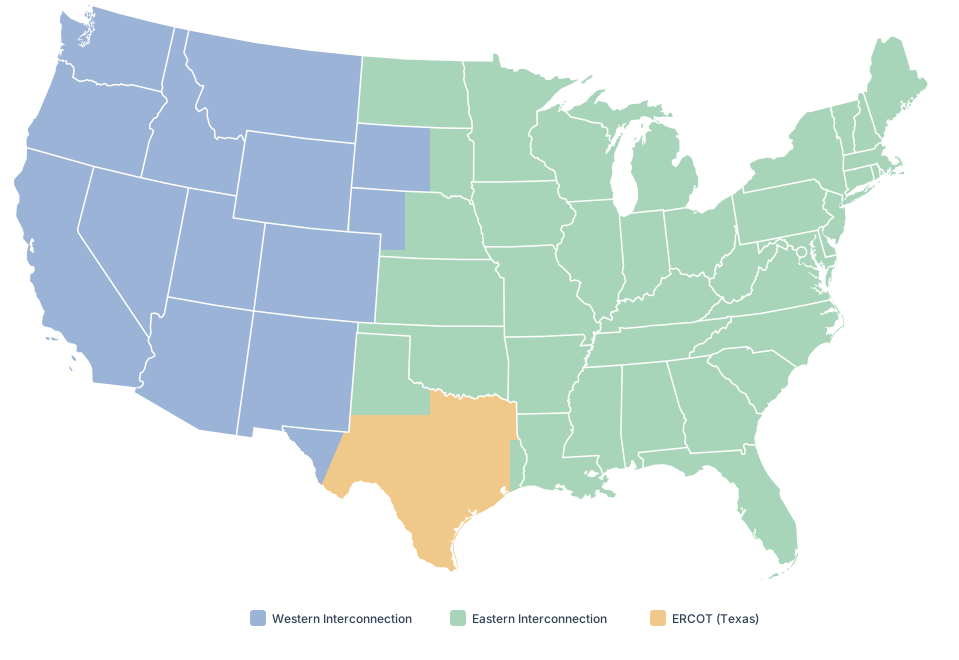
Within each interconnection, regional grid operators manage the flow of electricity. These are called ISOs (independent system operators) or RTOs (regional transmission organizations). The two terms are functionally interchangeable: both refer to independent, nonprofit entities that coordinate the grid across multiple utility territories. They decide which power plants run at any given moment, manage transmission access, and process interconnection requests for new generators and large loads. The key idea is that the ISO/RTO operates the grid but does not own the power plants or transmission lines. That separation is meant to ensure that all generators compete on equal terms.
Not all of the US is covered by an ISO/RTO. Much of the Southeast, including Georgia, is instead managed by vertically integrated utilities: companies that own generation, transmission, and distribution under one roof. Southern Company, for example, owns the power plants, the transmission lines, and the local distribution network that serves its customers. There is no independent grid operator sitting between the utility and the market. This means the utility itself decides which plants run, how much new capacity to build, and how to handle interconnection requests from large customers like data centers.
Coverage
13 states + D.C.
Serves
65 million people
Interconnection queue
~2,600 projects (all types)
Queue wait
4+ years median
Key stat
Largest US data center market
Coverage
Most of Texas
Serves
27 million people
Interconnection queue
226 GW in large-load requests
Queue wait
Faster historically, now backlogged
Key stat
6.5 GW under construction
PJM is the most important ISO for data centers. It covers the Mid-Atlantic and parts of the Midwest, including Northern Virginia, the world's largest data center market. [15]NRDC, "Building Data Centers Without Breaking PJM" (2025)https://www.nrdc.org/bio/tom-rutigliano/building-data-centers-without-breaking-pjm
Every year, PJM runs a capacity auction where power plants bid to guarantee they will be available when needed. Utilities pay into this auction so that enough generation exists to cover peak demand. In 2024, the total cost of that guarantee surged to $14.7 billion for the 2025-2026 period, up 833% from the prior year. Data center demand growth was responsible for 63% of that increase. [15]NRDC, "Building Data Centers Without Breaking PJM" (2025)https://www.nrdc.org/bio/tom-rutigliano/building-data-centers-without-breaking-pjm
ERCOT operates independently from the Eastern and Western Interconnections, which means it falls outside FERC's interstate jurisdiction. ERCOT's large load queue nearly quadrupled in a single year, reaching 226 GW of requests by November 2025, more than double ERCOT's entire installed generation capacity of roughly 105 GW. [16]Latitude Media, "ERCOT's large load queue has nearly quadrupled in a single year" (2025)https://www.latitudemedia.com/news/ercots-large-load-queue-has-nearly-quadrupled-in-a-single-year/ More than 70% of those requests are from data centers. [17]ERCOT, "System Planning and Weatherization Update" (December 2025)https://www.ercot.com/files/docs/2025/12/02/16.2-System-Planning-and-Weatherization-Update_Revised.pdf ERCOT has acknowledged its process can't keep pace and began launching reforms in early 2026, including a dedicated team to process requests faster. [18]Utility Dive, "ERCOT's large load queue jumped almost 300% last year" (2025)https://www.utilitydive.com/news/ercots-large-load-queue-jumped-almost-300-last-year-official/808820/
ERCOT is unique among US grid operators. Because it operates entirely within Texas and does not cross state lines, it falls outside federal regulation by FERC. That independence gives Texas several advantages for data center operators: faster permitting timelines, fewer regulatory layers, more available land, and lower power costs in parts of the state. Texas also has a competitive electricity market (meaning generators compete to sell power wholesale and customers choose their retail provider), which gives operators more flexibility in structuring power arrangements. These advantages explain why Texas has 6.5 GW of data center capacity under construction and why major projects like Stargate chose Texas over more established markets.
The tradeoff is reliability. The February 2021 winter storm caused widespread power outages across Texas that lasted days. Because ERCOT is isolated from the other two interconnections, no neighboring grid could send backup power. For a data center operator, this isolation is a real risk: there is no fallback if the Texas grid fails. [19]FERC/NERC, "February 2021 Cold Weather Outages in Texas and the South Central United States" (2021)https://www.ferc.gov/media/february-2021-cold-weather-outages-texas-and-south-central-united-states-ferc-nerc-and
What operators are doing about the power bottleneck
Three strategies have emerged: build your own power, contract directly with a power plant, or go where the grid has capacity.
Behind-the-meter generation
Instead of waiting for a grid connection, a data center can build its own power plant on-site and generate its own electricity. This is called behind-the-meter generation because the power never passes through the utility's meter or grid.
xAI's Colossus facility in Memphis is the most visible example. The facility launched in September 2024 with roughly 150 MW of IT load but an initial grid connection of only about 8 MW from the local utility. To fill the gap, xAI installed dozens of natural gas turbines on-site. Aerial imagery from April 2025 showed 35 gas turbines at a combined capacity of roughly 422 MW. [20]Data Center Dynamics, "xAI doubles number of onsite gas turbines at Memphis data center" (2025)https://www.datacenterdynamics.com/en/news/xai-doubles-number-of-onsite-gas-turbines-at-memphis-data-center-in-violation-of-permit-limits/
The turbines operated without air quality permits required under the Clean Air Act (the federal law regulating emissions from power plants and industrial facilities), drawing legal challenges from the Southern Environmental Law Center [21]SELC, "xAI built an illegal power plant to power its data center" (2025)https://www.selc.org/news/xai-built-an-illegal-power-plant-to-power-its-data-center/ and regulatory action from the EPA. Shelby County granted an air permit in July 2025 for up to 15 turbines generating about 247 MW, valid through January 2027. [22]CNBC, "Musk's xAI scores permit for gas-burning turbines to power Grok supercomputer in Memphis" (2025)https://www.cnbc.com/2025/07/03/musks-xai-gets-permit-for-turbines-to-power-supercomputer-in-memphis.html
Direct power purchase agreements (PPAs)
A PPA is a long-term contract where a data center operator agrees to buy power from a specific generating station at an agreed-upon price. Microsoft signed a 20-year PPA with Constellation Energy in September 2024 to restart Three Mile Island Unit 1 in Pennsylvania. The plant, now renamed the Crane Clean Energy Center, has a capacity of 835 MW. Constellation is investing roughly $1.6 billion in the restart, with commercial operation targeted as early as 2027, ahead of the original 2028 schedule. [23]Constellation Energy, "One Year Later: Crane Clean Energy Center Still in the Spotlight and Ahead of Schedule" (2025)https://www.constellationenergy.com/newsroom/2025/09/one-year-later-crane-clean-energy-center-still-in-the-spotlight-and-ahead-of-schedule.html The deal secures nuclear baseload power (steady, always-on generation) that produces no carbon emissions for Microsoft's data centers without waiting in the interconnection queue for new generation.
Amazon pursued a more aggressive version of this strategy. Talen Energy sold a 960 MW data center campus adjacent to the Susquehanna nuclear plant in Pennsylvania to AWS for $650 million in March 2024. The original plan was to draw power directly from the plant, bypassing PJM's grid. FERC rejected the proposal in November 2024 [24]ANS Nuclear Newswire, "FERC denies Talen-Amazon agreement, again" (2025)https://www.ans.org/news/2025-04-16/article-6937/ferc-denies-talen-amazon-agreementagain/ and denied rehearing in April 2025, ruling that the arrangement didn't follow PJM's standard rules. Talen restructured: in June 2025, it signed a 1,920 MW PPA with AWS using a front-of-meter arrangement, where the power is sold through the grid like any other electricity transaction. [25]Utility Dive, "Talen to sell Amazon 1.9 GW from Susquehanna nuclear plant" (2025)https://www.utilitydive.com/news/talen-amazon-aws-susquehanna-nuclear-data-centert/750440/ This avoids the regulatory issues FERC flagged, but it means they still need enough transmission capacity to deliver the power.
The FERC rulings on Talen/Amazon set a precedent: behind-the-meter co-location (placing a data center physically next to a power plant and drawing power directly) at existing plants faces regulatory risk. Front-of-meter PPAs avoid that risk but depend on the grid having capacity to deliver the power.
Site selection
The third strategy is the simplest. Go where the power is. Power availability has overtaken fiber connectivity (high-speed internet connections to the facility) as the top factor in data center site selection. [26]Hanwha Data Centers, "Power Availability: The New #1 in Data Center Site Selection" (2025)https://www.hanwhadatacenters.com/blog/power-availability-the-new-1-in-data-center-site-selection/ The question has shifted from “where are my customers” to “where can I get power in 12 months.”
Texas is the biggest beneficiary. The state has 6.5 GW of data center capacity under construction, putting it on track to overtake Northern Virginia as the world's largest data center market by 2030. [27]Data Center Knowledge, "Could Texas Overtake Northern Virginia as the Data Center Capital?" (2025)https://www.datacenterknowledge.com/build-design/could-texas-overtake-northern-virginia-as-the-data-center-capital- OpenAI, SoftBank, and Oracle chose Abilene, Texas, for the initial Stargate site. [28]CNBC, "OpenAI's first data center in $500 billion Stargate project is up and running in Texas" (2025)https://www.cnbc.com/2025/09/23/openai-first-data-center-in-500-billion-stargate-project-up-in-texas.html Other states are attracting projects too: AWS has broken ground on an $11 billion campus in St. Joseph County, Indiana. [29]Data Center Dynamics, "AWS breaks ground on $11bn data center campus in Indiana" (2024)https://www.datacenterdynamics.com/en/news/aws-breaks-ground-on-11bn-data-center-campus-in-indiana/ In Northern Virginia, Dominion expects large-load interconnection timelines to stretch to seven years [30]Bloomberg, "Data Centers Face Seven-Year Wait for Power Hookups in Virginia" (2024)https://www.bloomberg.com/news/articles/2024-08-29/data-centers-face-seven-year-wait-for-power-hookups-in-virginia, pushing operators to new geographies or behind-the-meter generation.
All three strategies address the same constraint. The grid can't deliver power fast enough for the pace of AI deployment. Whether operators build their own generation, contract directly with power plants, or relocate to less congested markets, the underlying problem remains: the physical infrastructure that delivers electricity was not built for this level of demand growth.
References
- LBNL, "Queued Up: 2025 Edition, Characteristics of Power Plants Seeking Transmission Interconnection" (2025)
- EIA, "Delivery to consumers" (accessed March 2026)
- EIA, "How much electricity is lost in electricity transmission and distribution in the United States?" (accessed March 2026)
- NEI Engineering, "Grid Interconnection for Data Centers" (accessed March 2026)
- HDR, "Rethinking Data Center Power" (accessed March 2026)
- FERC, "Explainer on the Interconnection Final Rule" (2023)
- EIA, "After more than a decade of little change, U.S. electricity consumption is rising again" (2025)
- Grid Strategies via WRI, "Powering the US Data Center Boom" (2025)
- ACEG/Grid Strategies, "Fewer New Miles: The Pace of Transmission Construction" (2025)
- Data Center Dynamics, "Dominion Energy admits it can't meet data center power demands in Virginia" (2025)
- Virginia SCC, "SCC Issues Order on DEV Biennial Review 2025" (2025)
- Georgia Recorder, "Georgia regulators approve massive power grid expansion to serve data centers" (2025)
- Georgia General Assembly, "HB 1012: Prohibit construction of new data centers for a specified time" (2026)
- Science for Georgia, "Data Centers: Big Power, Small Jobs" (2025)
- NRDC, "Building Data Centers Without Breaking PJM" (2025)
- Latitude Media, "ERCOT's large load queue has nearly quadrupled in a single year" (2025)
- ERCOT, "System Planning and Weatherization Update" (December 2025)
- Utility Dive, "ERCOT's large load queue jumped almost 300% last year" (2025)
- FERC/NERC, "February 2021 Cold Weather Outages in Texas and the South Central United States" (2021)
- Data Center Dynamics, "xAI doubles number of onsite gas turbines at Memphis data center" (2025)
- SELC, "xAI built an illegal power plant to power its data center" (2025)
- CNBC, "Musk's xAI scores permit for gas-burning turbines to power Grok supercomputer in Memphis" (2025)
- Constellation Energy, "One Year Later: Crane Clean Energy Center Still in the Spotlight and Ahead of Schedule" (2025)
- ANS Nuclear Newswire, "FERC denies Talen-Amazon agreement, again" (2025)
- Utility Dive, "Talen to sell Amazon 1.9 GW from Susquehanna nuclear plant" (2025)
- Hanwha Data Centers, "Power Availability: The New #1 in Data Center Site Selection" (2025)
- Data Center Knowledge, "Could Texas Overtake Northern Virginia as the Data Center Capital?" (2025)
- CNBC, "OpenAI's first data center in $500 billion Stargate project is up and running in Texas" (2025)
- Data Center Dynamics, "AWS breaks ground on $11bn data center campus in Indiana" (2024)
- Bloomberg, "Data Centers Face Seven-Year Wait for Power Hookups in Virginia" (2024)
Frequently Asked Questions
How does a data center connect to the electrical grid?
A data center drawing 20 MW or more connects at the transmission level (69-230 kV) through a dedicated substation, unlike homes which connect at the distribution level (120/240V). A 100 MW facility typically requires its own substation with two independent utility feeds for redundancy. The operator usually pays for the substation or splits the cost with the utility, and construction takes 2-4 years.
How long does it take to get grid power for a new data center?
The median time from interconnection request to commercial operation has doubled from under two years (2000-2007) to over four years (2018-2024), according to LBNL. In congested markets like PJM (Northern Virginia), wait times can stretch even longer. Only 13% of interconnection requests submitted between 2000 and 2019 reached commercial operation by end of 2024.
Why is there a power bottleneck for AI data centers?
US electricity demand was flat for nearly two decades, so utilities planned for modest growth. AI data center demand appeared as a step function starting in 2023. Building new transmission lines takes 7-12 years. Utility five-year peak demand forecasts jumped from 38 GW to 128 GW in a single year (2023 to 2024). The grid planning process was not designed for this rate of change.
What are operators doing to bypass grid constraints?
Three main strategies: behind-the-meter generation (building on-site power plants, as xAI did in Memphis with 422 MW of gas turbines), direct PPAs with existing generators (Microsoft signed a 20-year PPA with Constellation to restart Three Mile Island at 835 MW), and site selection based on grid capacity rather than proximity to users (Stargate chose Abilene, Texas; Texas has 6.5 GW under construction).
We help emerging neoclouds find financing partners, and help financing partners enhance story credit with GPU collateral management and residual value insurance solutions.
Learn how it works →